-

-
Industry Information
- Solutions
- Products
- Support
- Services System
- Services & Support
- Services Network
- Service Platform



- Solutions
The current new era of Internet of Everything is constantly reconstructing traditional industries and operating models and business models. Facing the ever-increasing demand for service connectivity, from network structure to service model are being reconstructed to adapt to the opportunities and challenges of the digital age. As 5G accelerates the deepening reform and digital transformation of society, the service model of operators has also undergone profound changes, from 2G voice operation, 3/4G traffic operation to the 5G era network operation. In the future, if you want to achieve commercial success in the blue ocean of 5G, experience will exceed technical indicators and become an important consideration for users. At the same time, VIP users are also willing to pay an extra premium for the ultimate experience when facing homogeneous private lines.
Smart optical network is an important base for satisfying user experience and an important key for operators to provide differentiated services for network operations. As early as 2019, FiberHome launched its smart optical network solution and proposed the four core concepts of “ubiquitous, ultra-wide, open, and on-demand”. In 2020, it focused on the realization of the goal of Naas to help the commercialization of the network, and proposed “upgrading capacity, upgrading experience, operational upgrade". This year, based on years of practice, FiberHome has enriched the connotation of NaaS operations, that is, through the two-level architecture of "all-optical foundation" + "smart brain", FiberHome have outlined the blueprint of 5G government-enterprise all-optical private line.
At the PT Expo 2021, which just came to an end, FiberHome demonstrated its 5G all-optical private line solution, which fully demonstrated FiberHome’s comprehensive strength in the field of optical transmission.
All-optical Foundation
In terms of ultra-wide pipelines, how to achieve ideal results in terms of spectrum efficiency and transways been the focus of research in the industry. FiberHome has made breakthroughs in the two key technologies of "probabilistic shaping" and "Nyquist subcarrier". This is reflected in the single-wave 800G ultra-long-distance transmission, which is three times better than the previous generation technology, making the 800G technology large-scale urban Domain deployment becomes possible. In terms of system capacity improvement, FiberHome can currently provide a 220-wave system implementation scheme based on the "C+L" band. Through the combination of high speed and ultra-wide, the single fiber capacity has been increased by 11 times.
In terms of all-optical scheduling, FiberHome OXC all-optical crossover technology, including optical flexible backplanes, highly integrated boards, optical OAM based on optical tags, and other technologies, can effectively save 90% of the communication room space and reduce power consumption by 60% compared to the traditional ROADM architecture. FiberHome has also made breakthroughs in miniaturizing OXC. Currently, it has launched the most compact 16-dimensional OXC equipment in the industry. Deploy OXC at the core node and deploy a miniaturized OXC at the integrated access node to achieve all-optical forwarding from cloud to end, which greatly reduces latency and can achieve ms-level latency. Once jumped into the cloud, it will give end users extremely low latency experience
In terms of openness and disaggregation, FiberHome realizes the interoperability of services of different manufacturers through the standard IrDI interface and realizes the unified management and control of different manufacturers through the standard southbound interface. Through this horizontal and vertical disaggregation, it helps operators break the barriers of different manufacturers and achieve end-to-end service and control.
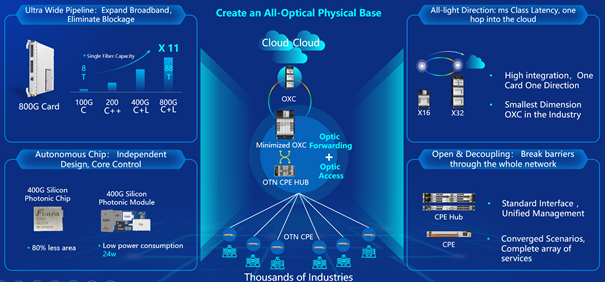
In terms of independent research and development, at present, FiberHome has been able to independently design OTN core chips in optical network products, and has also made major breakthroughs in the field of silicon optics. The self-developed 400G silicon optical chip can reduce the area by 80% compared with ordinary electric chips, so that the power consumption of the silicon optical module can be as low as 24w.
Smart Brian
The complexity of the network and the high cost of failures have pushed AI technology to the forefront of the communications industry. The operation and maintenance mode of optical network has gradually evolved from manual operation and maintenance in the past to automated operation and maintenance. The application of AI in optical networks can build a more intelligent and efficient network. Intelligent operation and maintenance through AI, such as rapid fault location and network health analysis, etc. FiberHome has deployed AI in the three key areas of "algorithm, computing power, and data": the data field relies on the massive data generated by the operation of a large number of devices on the existing network as a training database; in terms of computing power, the introduction of powerful computing power dedicated AI at the device level Chips, and use the "centralized + distributed" two-level architecture to process data; in terms of algorithms, FiberHome puts forward its own unique four core algorithms: index sequence construction method, feature decomposition cleaning method, correlation coefficient enhancement method, deep simulation combined prediction method greatly improves the accuracy of failure analysis and network prediction. Reflected in the operation and maintenance, finally achieved the effect of increasing the operation and maintenance efficiency by 85% and reducing the failure rate by 60%.
The perception of "user experience" is ubiquitous, and the smart brain can provide end customers with an e-commerce-style experience. Based on the UMC² management and control platform, FiberHome’s cloud native APP, such as traffic visualization, allows users to grasp the status of traffic usage in real time; bandwidth calendar, users can change bandwidth as needed to achieve second-level changing; delay map, users can optimize as needed service routing; these apps can help operators give end users a visual, sensible, and on-demand experience.
FiberHome believe that on the road of digital transformation of the 5G society, the evolution to the smart optical network is the only way for the development of optical networks. The smart optical network will surely release the new value of optical networks, help customers succeed in business, and help the digital transformation of society succeed.
The FiberHome EPC Solution Con...
Upgrade Gigabit Fiber Network ...
Upgrade Gigabit Fiber Network ...
Dating with Winter Olympics...