Recently, according to the overall arrangement of China Unicom's 400G test network, under the planning guidance of the Network Department of China Unicom Group and China Unicom Research Institute, Guangdong Unicom and FiberHome built China’s first C+L band 400G test network. Based on this network, FiberHome and China Unicom completed the verification of key projects such as business functions, performance, OMSP protection switching, and smooth upgrade of C+L system, and successfully passed the acceptance. The completion of this experimental network marks a crucial step forward for 400G from laboratory testing to mature commercial use in the current network.
With the implementation of the national strategic project of "Channel computing resources from the east to the west", the digital economy empowers thousands of industries. China Unicom released the Action Plan for China Unicom's New Digital Information infrastructure, and actively built four quality networks: 5G quality network, gigabit broadband quality network, government enterprise quality network, and computing quality network. The all-optical base is a key element to support the construction of these four quality networks, aiming to achieve high-speed direct access to computing, super bandwidth, flexible scheduling, and low latency through the all-optical transmission base. Therefore, conducting 400G experimental network testing in various scenarios is particularly important.
This test built a 96 × 400G ROADM network in the Pearl River Delta region covering three cities, Guangzhou, Shenzhen and Dongguan. It utilizes single wave 400G, constellation probability shaping (PCS) 16QAM modulation code type (91.6G and 107G Baud), C48+L48 extended band and other industry-leading optical transmission technologies and equipment. The pure EDFA amplification technology supports 100/400G multi rate service mixed transmission, C+L smooth upgrade, online OTDR monitoring and other functions. The project verification content and system indicators meet the expectations.
The main features of the system are presented from three aspects:
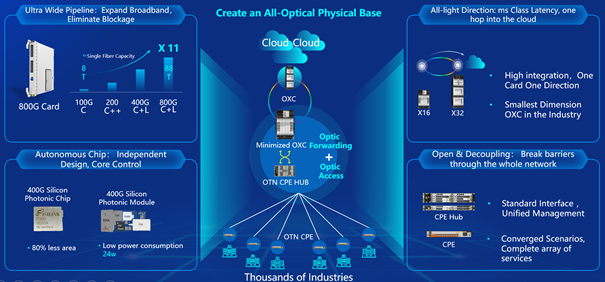
System capacity: The optical layer uses a single wave 400G board card, using the existing network G.652D fiber, which can support up to 96 waves and provide 38.4T of super large system capacity. This is the largest transmission capacity of the industry's internal test network layer, providing large bandwidth flow interconnection between four core key cities, and creating a high-speed and low latency all-optical interconnection base.
System performance: EDFA amplification technology with low engineering cost and high factor of safety was adopted, and the system OSNR and other test indicators meet the expectations, indicating that the PCS 16QAM modulation code type can meet the transmission requirements between provincial trunk line and metro core nodes (the OSNR indicators of the 107G Baud system were better).
Smooth upgrade: the existing trunk transmission network of operators is dominated by 100/200G. How to smoothly upgrade to 400G in the future is an urgent issue. At the same time, the SRS effect of optical fiber will make the optical power transfer from C to L when C-band is extended to C+L band, leading to system performance degradation; Through this test, FiberHome has provided corresponding solutions that can achieve lossless business cutover and smooth upgrade.

Wang Guangquan, Chief Engineer of China Unicom Research Institute, stated that the application and commercial deployment of 400G technology needs to take into account the actual network conditions of operators, without changing the transmission network architecture, especially the settings of optical terminals and switching nodes. It is necessary to try not to change the type of optical cables in the current network, not to change the settings of existing computer rooms, optical amplifiers, and relay stations, and not to change operation and maintenance habits. In order to minimize the additional costs brought about by system upgrades to the lowest. This test utilizes all existing computer rooms, power supplies, and optical cables, inheriting traditional operation and maintenance habits, maximizing the protection of existing investments by operators without additional maintenance costs, and directly increasing the single wave rate from 100G to 400G. It not only improves system capacity but also reduces single bit transmission power consumption, which is an important component of building a solid all optical base.
Over the past year, Guangdong Unicom has actively implemented the National Cyber Power Strategy, accelerated the construction of new Information infrastructure, and continued to promote the unification of the Bay Area optical network. The successful 400G pilot test has doubled the single wave rate and spectrum band, greatly expanded the Bay’s area all-optical ultra-high speed and low delay network carrying space, improved the comprehensive carrying capacity. Which has stepped up the network quality to a new level, and supported the construction and development of the Guangdong–Hong Kong–Macao Greater Bay Area digital economy.
The successful completion and acceptance of the Guangdong Unicom 400G experimental network marks the further maturity of key 400G technologies, laying a solid foundation for the future commercial and next step of ultra-high speed transmission technology evolution. FiberHome will continue to work with industry partners to jointly tap the value of digital connectivity, build a solid all-optical base in the computing age, enable the Digital transformation of thousands of industries, support the high-quality development of the national digital economy, and benefit the human society.