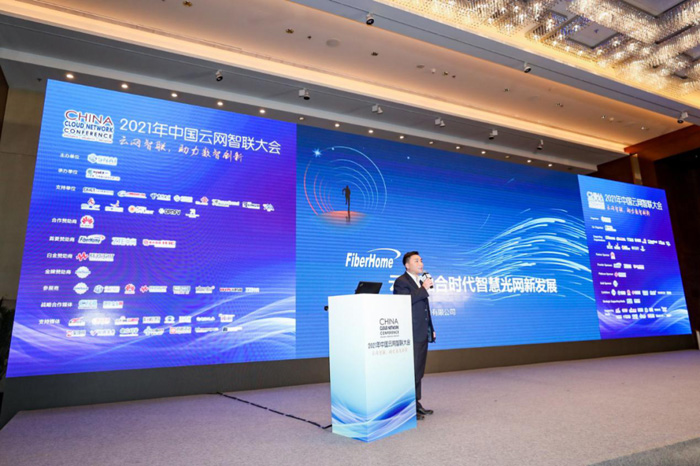
On April 14, the "2021 China Cloud and Network Intelligence Conference" with the theme of "Cloud and Network Intelligence, Helping Digital Intelligence Innovation" was grandly held in Beijing. At the meeting, the three major operators, Internet companies, and equipment vendors introduced their views and progress about how to build cloud-network integration infrastructure, using network capabilities to support the development of cloud computing, using cloud computing concepts to optimize network resources, and finally making network resources adapt to the ever-changing needs. They also discussed other related topics.
Zhan Yichun, Planning Director of FiberHome Network Business Unit, delivered a keynote speech on "New Development of Smart Optical Network in the Era of Cloud-Network Convergence" at the conference. Zhan Yichun elaborated on the main key technologies, business strategies, industry trends and future development trends of global operators in the era of cloud-network convergence, and proposed that smart optical networks will continue to help the cloud in the direction of "ubiquitous, ultra-wide, open, and on-demand" The construction and development of network infrastructure, and analyzes the opportunities and challenges faced by smart optical networks under the trend of digital transformation of the industry under the integration of cloud and network.
The essence of cloud network integration is the integration of IT and CT
1
Cloud and the Internet provide computing and connection services for the key production factors "data" in the development of the digital economy and can be regarded as an important infrastructure for digital transformation and new infrastructure work. Cloud-network integration is a process in which cloud and network continue to deepen coupling, learn from each other's strengths, and continue to evolve. The key to cloud-network integration lies in "fusion". Its technical connotation is the basic resource layer of cloud and network. Through the implementation of virtualization, cloudification and even integrated technical architecture, the resource supply of new information infrastructure is finally realized.
The telecom operators have a consensus of cloud network integration.
Operators are actively learning from Internet companies how to use intensive methods such as cloudification and virtualization to improve resource utilization efficiency. Cloud-network integration provides platform basic capabilities for business ecology and promotes industry cross-industry integration and value generation.
Zhan Yichun said: "Currently it is the convergent period of two waves of cloud migration requirements, both cloud and the Internet are facing various challenges such as heterogeneous, intensive, unified operation and maintenance, reliability, and security."
How to promote cloud-network integration
2
The key technical goals of cloud-network integration are mainly reflected in three aspects: network movement with cloud, network cloudification, and cloud-network capability improvement.
The network moves with the cloud: Network resources need to be differentiated for the cloud, providing nearby access, multi-cloud access and interconnection, and cloud-side collaboration. The network connection needs to meet the requirements of agile deployment and dynamic scaling of cloud services, and realize the unified automatic opening, scheduling, and optimization capabilities of the cloud and network. Network capabilities need to be unified encapsulated and flexibly adjustable in the dimensions of connection, QoS, data, etc. according to the customized requirements of cloud applications.
Network cloudification: network architecture needs to reduce levels, improve connection efficiency, and facilitate large traffic flow. New network elements should use open source and decoupling cloud deployment methods as much as possible to realize the separation of transfer and control, improve the versatility and manageability of network resources, and facilitate integrated management, control, and orchestration. The software system should adopt microservices and cloud-native design to fully connect cloud and network resources, shield the differences in underlying hardware and professional technology, and realize the openness of the network to the outside world.
Cloud network capability enhancement: The focus of cloud network capabilities is to expand to DICT services that integrate AI, big data, and other comprehensive capability elements. Based on providing sufficient IaaS products, it will move towards a feature-rich PaaS platform and a diverse SaaS ecosystem with diverse applications. The mastery of cloud network technology, based on solving business distribution and operation management technology, develop to independent and controllable functional software and operating systems.
On how to promote cloud-network integration, Zhan Yichun introduced:
On the one hand, network operations must be transformed from the traditional vertical and vertical professional division of labor to horizontal and horizontal integrated hierarchical management, and multiple infrastructure resources must be coordinated and shared. On the other hand, it is necessary to unify the network capability and data capability open system and promote the network orchestration of CT+IT and the R&D and operation of customer-oriented business at the application level. In this way, applications, cloud platforms, and networks are deeply integrated to create a service model of "slicing on demand" to provide customers with cloud and network slicing services. In the process of opening the network to the cloud and providing the network's atomic capabilities for cloud invocation, it involves the integration of device forms, deployment methods, and networking architecture.

Smart optical network facilitates the integrated development of cloud networks
3
The rigid demand of cloud for intelligent optical network is capacity improvement and reliable connection. Quality assurance and experience improvement are the requirements of extended development, which has become the embodiment of the differentiated competitiveness of operators.
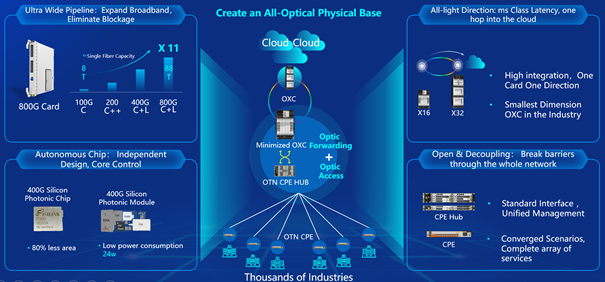
Extra-wide is the eternal theme of the optical networks. Operators have deployed hundreds of 100G commercial transmission networks around the world, with mainline networks starting to deploy single-wave 200G due to capacity requirements, and metropolitan areas considering 400G and higher rates. With the substantial increase of service bandwidth particles, the economy and power consumption of multi-cabinets combination based on electricity are difficult to support. The photoelectric hybrid and cross node scheduling technology can consider the flexibility of small particle business and the high bandwidth and low delay requirements of large particle business, which is the mainstream at present. In terms of optical layer scheduling, ROADM technology has been very mature, but in complex MESH or large node in stereo network, such as light direction over 12 dimensions, they are faced with problems such as complex interconnection fibers and excessive number of cabinets, while OXC can effectively solve the above problems through the introduction of all-light backboard.
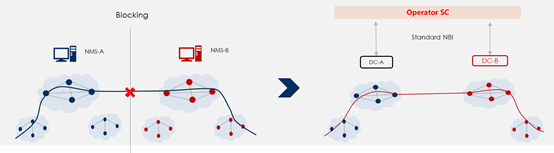
Smart optical network's customization ability is getting stronger and stronger, mainly reflected in the efficient carrying capacity of small particle business. Based on the differentiated network services of hard and soft slices, as well as the deployment adaptability of the scene, FiberHome’s innovation in the capability of small particle hard pipes and hard and soft slices has realized the M-grade granular rigid pipes, greatly improving the bandwidth utilization. In terms of scenario-based deployment, intelligent optical network provides effective support for network ubiquiality, multi-service access and cloud network integration deployment through form cutting, high integration and open decoupling.
The optical network operation and maintenance model has gradually evolved from manual operation and maintenance in the past to automated operation and maintenance. With the continuous growth of services and the expansion of network scale, AI will cover the entire life cycle of "planning, construction, maintenance, and optimization" of the transport network in the future. . At present, AI is mainly applied in the network field based on big data analysis based on the hosting control platform, and in the future, it will completely involve "equipment, platform, and application." The optical network provides support for fault location, congestion prevention and control, especially the prediction of slow-changing faults through endogenous "computing power". The application of AI in optical networks can build a more intelligent and efficient network, such as automatic alarm correlation, intelligent root cause analysis, and intelligent troubleshooting.
In the era of cloud-network convergence, smart optical networks will continue to evolve in the direction of "ubiquitous, ultra-wide, open, and on-demand". Based on network architecture adjustments that match the layout of cloud-side infrastructure, the introduction of new technologies with practical guidance. Through bandwidth upgrades, network sinking, improved coverage, and intelligent operation and maintenance, FiberHome's smart optical network solutions for cloud-network integration can efficiently support the entry the key requirement of cloud and networking is also an important practice of FiberHome as a mainstream ICT manufacturer to help cloud and network integration.
Zhan Yichun finally said: "FiberHome will work with industry partners to promote the development of smart optical networks, and continuously improve the resource and service awareness, ubiquitous connectivity, open sharing capabilities, and business innovation capabilities of optical networks."