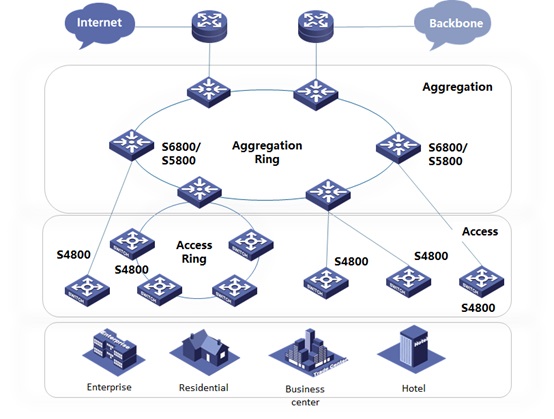
FiberHome CiTRANS R800 series are enhanced IP/MPLS router solution which combine the dynamic flexibility of routers, and the quick service deployment with easy and friendly GUI (graphical User Interface) NMS (Network Management System). In addition to affluent IP/MPLS features, R800 provide end-to-end QOS solution and high-precision clock synchronization for operators or subscribers. CiTRANS R800 series cover all the network layers, which support switching capacity from 8Gbps to 1.28Tbps. CiTRANS R800 series are applied for Carrier Ethernet applications include business services, such as Layer 2 and Layer 3 VPN, IPTV, mobile backhaul transport networks, and broadband network gateway, etc, through a unified network architecture.
As a member of the CiTRANS R800 enhanced router solution, CiTRANS R820 can be deployed as access node in Metropolitan Area Network (MAN). CiTRANS R820 is a compact, high-capacity provider edge router.
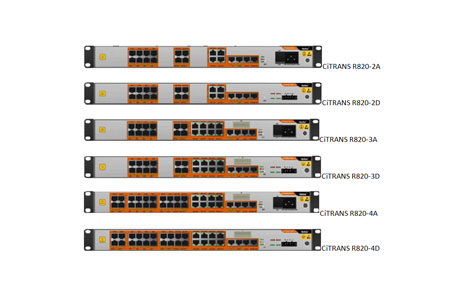
CiTRANS 820 is space saving design and can be installed in the 300mm depth Rack or Desktop, 1U height to support 16G/20G/64G accessing capacity
Average power consumption is 30% less than other vendor due to lower PC chip widely adopted
The intelligent fan unit providing excellent and flexible heat dissipation can simply conquer the challenges caused by harsh environment in both high and low temperature
With distributed hardware forwarding and non-blocking switching technology, CiTRANS R820 supports L2/L3 access and forwarding for multi-type services
Support variety and high density ports which includes 10GE, GE, FE and E1
Support L2VPN based on Martini protocol VPWS, VPLS
Support L3VPN based on MPLS/MBGP protocol: dynamically distribute VPN routes and VPN labels
Support PWE3 to simulate different media service
Provide perfect H-QoS mechanism(Including Traffic Classification, Traffic Policing, Queue scheduling, Congestion Avoidance, Traffic Shaping)
Support IP multicast service based on IGMP, PIM-SM/DM, Static multicast group, etc.
Support dual-stack: IP / MPLS OAM and IETF MPLS-TP OAM
Support smooth evolution from IPV4 to IPV6
Plug and play without onsite commissioning. Supports remote software upgrade in a batch manner.
Support remote online test according to RFC2544
Support Y.1731 LB/LT/DM/LM
Support PW ping/traceroute
Support CFM OAM, BFD, MPLS/MPLS-TP OAM
Support RIP, OSPF, IS-IS, BGP and static routing
Support Routing Policy (Route Mapping) and IP-Policy-based routing
Support TCP/IP protocol stack, including ICMP, IP, TCP, UDP, and ARP, etc
Support MPLS label forwarding, static LSP tunnel, LDP LSP, and RSVP-TE LSP also
Provide interface redundancy protection by adopting LAG technology
Support LSP 1+1/1:1 protection
Support IP FRR, TE FRR, PW Redundancy (for L2VPN), VPN FRR (for L3VPN), VRRP and etc., while single or multiple failures occurs.
Support single-hop or multiple-hop BFD (utilized OAM mechanism) for OSPF, ISIS, BGP, Tunnel, VPN FRR, and etc.
Supportprotocol-level GR (graceful restart)technology and device- level GR technology to provide uninterrupted NSF forwarding
Protocol-level GR includes OSPF GR, ISIS GR, BGP GR, LDP GR and etc.
Service link failurerecovery within 50ms, node failure recovery within 200ms,Service recovery without perception.
Support Sync-E, 1588V2, 1588 ACR .
GUI management module: consists of two parts, configuration management and monitoring management
The configuration management performs logical configuration, physical configuration, service configuration and area configuration
The monitoring management is the core of the OTNM2000 and provides service connection configuration, alarm query, performance query, and fault handling.Support dying gasp for integrated NMS and private NMS
Support Third-Party NMS for configuration and management
 With full IP/MPLS function support, CiTRANS R820 is an ideal choice for leased line service and 3G/LTE small cell.
| Feature | Specifications | ||
| R820-2(Standalone) | R820-3(Standalone) | R820-4(Standalone) | |
| Switching capacity | 16Gbps/20 Gbps /64 Gbps | ||
| Maximum/total interface capability |
GE(O): 8 GE/FE(O): 4 GE/FE(E): 4 |
GE(O): 8 GE/FE(O): 4 GE/FE(E): 8 E1: 16 |
10GE(O):4 GE(O): 12 GE/FE(O): 4 GE/FE(E): 8 E1: 16 |
| Interface synchronization processing |
External Clock Interface: 1PPS+TOD All physical ports can extract the clock information via sync E, Ethernet ports are all support 1588V2 |
||
| Physical dimensions (H*W*D, mm/in) |
44*440*225(mm) 1.73*17.32*8.86(in) |
44*440*226(mm) 1.73*17.32*8.90(in) |
44*440*227(mm) 1.73*17.32*8.94(in) |
| Standard 19-inch/21-inch equipment rack, 12-inch depth | |||
| Input voltage | Worldwide Ranging DC: -57.6V to -40V | ||
| Power consumption |
<38W typical | <46W typical | <52W typical |
| Weight | 2.60kg (5.73lb) | 2.72kg(6.00lb) | 2.78kg(6.13lb) |
| Operating temperature |
-40°C to +65°C (-40°F to +149°F) | ||
| Relative humidity | 5% to 95% | ||
| Operation altitude | Lower than 4000 m (13123.2 ft) | ||
| Electromagnetic compatibility standards |
ETSI EN 300 386, EN 55022, EN55024, EN 61000-4-2, EN 61000-4-3, EN 61000-4-4, EN 61000-4-5, EN 61000-4-6, CISPR 22, CISPR 24, ITU-T K.20, ITU-T K.21, ITU-T K.43, ITU-T K.44 |
||
| Safety standards | EN 60825-1, EN 60825-2, EN 60950-1, IEC 60825-1, IEC 60825-2, IEC 60950, UL 60950-1 | ||