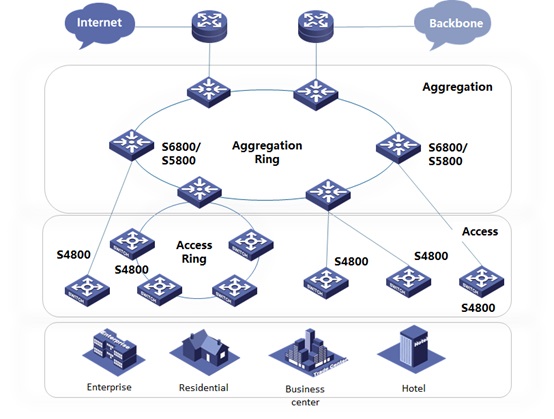
FiberHome FitCER is a pure software enterprise access router that runs on a standard server virtual machine, one of NFV products. Wide NFV deployment can effectively reduce capital expenditure (CAPEX) of carriers and enterprise clients. The virtualization technologies enable us to deploy and update network functions based on actual demands, greatly improving remote management and maintenance convenience and efficiently reducing operating expense (OPEX). The FitCER series consist of three models: FitCER1000, FitCER2000, and FitCER3000 series for different scenarios. FitCER3000 cloud enterprise router deployed on VM, flexible deployment, elastic scalability.
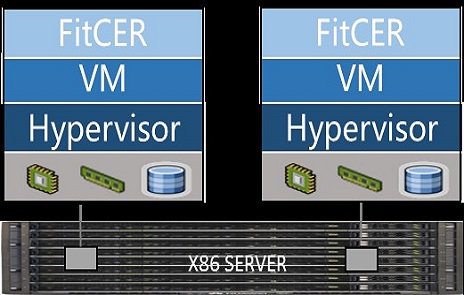
It separates the control plane from the data plane and supports multi-core data forwarding, improving the utilization of computing resources.
Modularized architecture and open network platform.
Abundant user authentication modes.
Automatic authentication online without manual intervention.
It supports site-to-site, site-to-dc, site-to-Internet, and other typical networking scenarios.
EVPN over VXLAN, and L2VPN and L3VPN enterprise leased line application scenarios.
Abundant routing protocols, including static routing, Routing Information Protocol (RIP), Open Shortest Path First (OPSF), Border Gateway Protocol (BGP) etc.
Supports IPSec, ensuring the network communication security.
Supports VXLAN over IPSec tunnel, having both the openness and security.
Intelligent routing policy or other user policies allow traffic on enterprise leased line to run on different underlying bearer networks, so as to improve the performances of leased line.
Built-in DHCP server can respond to the DHCP requests from downlink hosts and automatically allocate IP addresses in the IP address resource pool.
WAN-port double uplink protection realize active/standby protection.
Zero-transportation and zero-wiring deployment mode accelerates service deployment.
Supports platforms such as VMware ESXi, FitTelecomOS Cloud Platform and Linux KVM to realize batch deployment, image backup, quick restoration and flexible migration.
Supports various formats such as ISO, OVA, IPE and QCOW2 to adapt to different deployment environments.
Supports local deployment and flexible deployment of virtual machine management platforms and network management platforms.
Supports operators building POP networks in a virtualized environment, deploy and manage network resources and services on demand.
Dynamically adjusting VM resources and licenses, smooth software upgrades and on-demand performance upgrades can be achieved to meet business growth requirements at any time.